



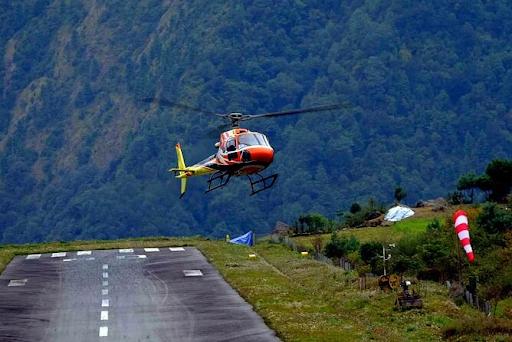
The journey from Kathmandu to Lukla Helicopter Flight represents one of the most critical legs of any Everest region adventure, serving as the primary gateway to the Khumbu Valley and its legendary trekking routes. While fixed-wing flights have traditionally dominated this route, helicopter flights have increasingly become the preferred choice for travelers seeking reliability, flexibility, and an enhanced travel experience. This transition reflects evolving expectations in adventure travel and the practical advantages that helicopter transportation offers in Nepal’s challenging mountain environment.
The Lukla Factor: Understanding the Destination
Lukla’s Tenzing-Hillary Airport holds the distinction of being one of the world’s most extreme airstrips, perched at 2,845 meters on a mountainside with a runway measuring just 527 meters in length. The runway features a dramatic 12-degree gradient, with one end terminating at a sheer drop into the valley below and the other ending at a stone wall built into the mountain. These characteristics have earned it a reputation as the world’s most dangerous airport, though experienced pilots navigate it daily with remarkable safety records.
Understanding Lukla’s unique challenges helps explain why helicopter flights have gained prominence. Traditional fixed-wing aircraft operate on rigid schedules heavily dependent on weather windows, often departing only in early morning hours when conditions are most stable. Delays and cancellations are common, sometimes stranding trekkers for days and disrupting carefully planned itineraries. Helicopters, with their superior maneuverability and ability to operate in more varied conditions, offer solutions to many of these challenges.
The Helicopter Advantage: Speed Meets Flexibility
A helicopter flight from Kathmandu to Lukla typically requires 40 to 50 minutes of actual flight time, compared to the 30 to 35 minutes of a fixed-wing aircraft. However, this slight time difference becomes negligible when considering the overall travel experience. Helicopters can depart throughout the day rather than being restricted to morning slots, providing schedule flexibility that proves invaluable for international travelers coordinating with connecting flights or dealing with jet lag.
The ability to adjust departure times in response to weather patterns represents perhaps the most significant advantage. While fixed-wing flights often cancel entire schedules if morning conditions are unfavorable, helicopter operators can wait for weather windows that open later in the day. This adaptability dramatically reduces the likelihood of multi-day delays that can derail entire trekking expeditions and create cascading complications for travelers with fixed return dates.
Weight restrictions on helicopters are generally more generous on a per-passenger basis than the strict limits imposed on small fixed-wing aircraft flying into Lukla. Trekkers can bring necessary gear without the anxiety of baggage restrictions that sometimes force difficult decisions about what to leave behind. Additionally, helicopter departures from Kathmandu often utilize dedicated helipads rather than the main airport, streamlining check-in procedures and eliminating the chaos that can characterize the fixed-wing departure terminal during peak seasons.
The Journey: A Spectacular Transition
The flight path from Kathmandu to Lukla chronicles Nepal’s extraordinary geographic diversity within less than an hour. Departing from the Kathmandu Valley, situated at approximately 1,400 meters, the helicopter climbs over the valley rim, providing passengers with sweeping views of the capital city’s urban sprawl interspersed with golden-roofed temples and historic palace complexes that speak to centuries of Newari culture.
As the helicopter heads northeast, the landscape transforms rapidly. Terraced hillsides cascade down mountainsides in intricate patterns perfected over generations of agricultural practice. Villages connected by winding trails appear as small collections of buildings, smoke rising from cooking fires visible against the green backdrop. Rivers cut through valleys, their courses marked by the suspension bridges that represent vital links in Nepal’s mountain transportation network.
The middle section of the flight brings increasingly dramatic topography. Forested ridges give way to higher elevations where vegetation becomes sparser and the geology more exposed. On clear days, the Himalayan giants begin appearing on the northern horizon—tantalizing glimpses of the peaks that await trekkers in the days ahead. Cho Oyu, Lhotse, Ama Dablam, and occasionally Everest itself become visible, their summits often wearing characteristic cloud formations.
The final approach to Lukla provides an impressive demonstration of helicopter capabilities. While fixed-wing aircraft must commit to a straight-in approach aligned with the runway’s orientation, helicopters can maneuver more freely, adjusting their approach based on wind conditions and visibility. The touchdown at Lukla’s small helipad, situated near the main runway, offers passengers their first breath of mountain air and their first encounter with the distinctive atmosphere of this mountain gateway.
Practical Considerations for Travelers
Booking a Kathmandu to Lukla helicopter flight requires advance planning, particularly during the peak trekking seasons of March through May and September through November. Prices typically exceed fixed-wing fares significantly, reflecting the operational costs of helicopter aviation and the premium services provided. However, many travelers consider the additional expense worthwhile given the reduced risk of delays and the enhanced overall experience.
Helicopter flights can be arranged as private charters or shared flights, with pricing structures varying accordingly. Private charters offer maximum flexibility, allowing groups to set their own schedules and potentially include scenic detours or additional stops. Shared flights provide a more economical option while still delivering the core benefits of helicopter travel. Reputable operators maintain modern fleets specifically configured for high-altitude operations, with experienced pilots who navigate Nepal’s mountain environment daily.
Weather remains the ultimate arbiter of mountain aviation, and travelers should maintain realistic expectations. Even helicopters cannot operate in conditions of poor visibility, high winds, or severe precipitation. Building buffer days into trekking itineraries remains essential regardless of the transportation mode chosen. Insurance coverage that includes helicopter evacuation is strongly recommended, as medical emergencies in remote areas may necessitate helicopter extraction regardless of initial travel plans.
Environmental and Community Perspectives
The environmental impact of helicopter operations merits consideration within broader discussions of sustainable tourism in the Himalayan region. Helicopters consume more fuel per passenger-kilometer than fixed-wing aircraft, and their noise footprint affects both wildlife and human communities along flight paths. However, their efficiency in reducing overall travel time and their essential role in emergency services create a complex equation when evaluating their environmental cost-benefit ratio.
From a community perspective, helicopter operations provide employment for Nepali pilots, mechanics, and ground staff while supporting infrastructure development in mountain regions. The helicopter industry has proven instrumental in emergency response capabilities, enabling rapid medical evacuations and disaster relief operations that save lives in areas where road access remains impossible or impractical. This dual-use nature—serving both tourism and critical community needs—positions helicopters as integral components of Nepal’s mountain infrastructure.
Conclusion
The Kathmandu to Lukla helicopter flight represents far more than simple transportation between two points; it embodies a sophisticated solution to the logistical challenges inherent in accessing one of the world’s most spectacular mountain regions. By offering reliability, flexibility, and an extraordinary journey through Nepal’s vertical landscape, helicopter flights have established themselves as a premium option for serious trekkers and adventure travelers.
The decision to choose helicopter over fixed-wing transportation ultimately reflects individual priorities regarding budget, schedule certainty, and travel experience preferences. For those whose time is limited, whose tolerance for uncertainty is low, or who simply desire the enhanced perspective and comfort that helicopters provide, the additional investment delivers tangible value. As mountain tourism continues evolving and as technology advances, helicopter flights will likely play an increasingly central role in facilitating access to the Himalayas while maintaining the spirit of adventure that draws travelers to these extraordinary heights. The journey from Kathmandu to Lukla, whether by helicopter or fixed-wing, marks the beginning of transformative experiences in the shadow of the world’s highest peaks—a threshold crossed in anticipation of the wonders that await in the mountains beyond.
