



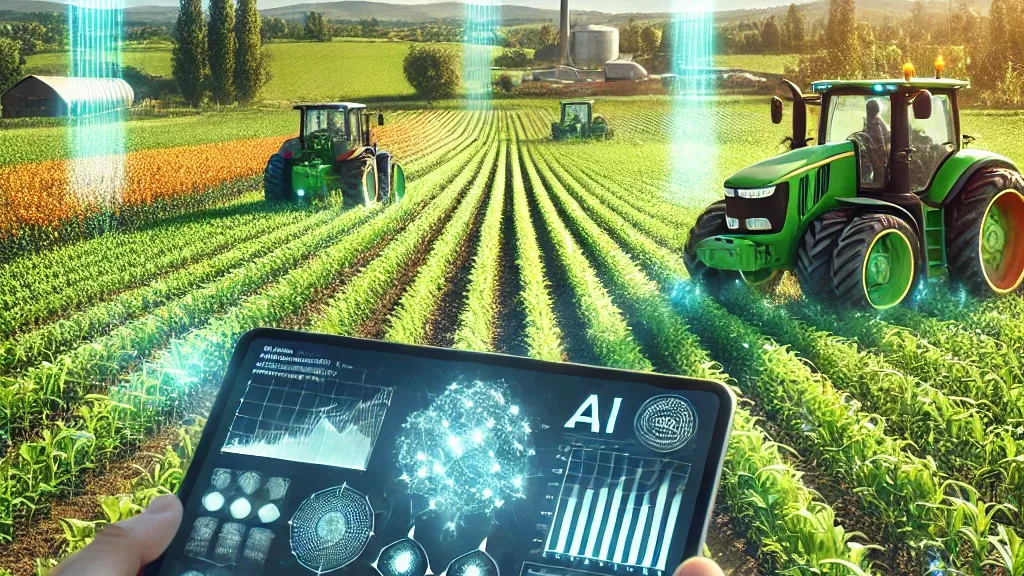
Agriculture faces a compound challenge: feeding a growing global population with a shrinking agricultural workforce, under increasingly variable climate conditions, on a finite land base that is subject to soil degradation and water stress. Precision agriculture powered by AI services and AI solutions is one of the most promising responses, enabling farmers to make better decisions about every input, every field zone, and every growing season rather than applying uniform treatments across diverse conditions.
Crop health monitoring using satellite imagery, drone surveys, and ground-based sensors generates data that AI vision models analyse to detect disease, pest pressure, nutrient deficiency, and water stress at sub-field resolution. Early detection of these problems enables targeted interventions with substantially less chemical input than broadcast treatments require, improving both economics and environmental outcomes. The ability to monitor entire farm operations continuously at this level of detail was simply not feasible before AI made the analysis scalable.
Yield prediction models that integrate soil profiles, historical yield maps, crop development observations, and weather forecasts generate pre-harvest yield estimates that inform procurement decisions, logistics planning, and financial hedging for agricultural value chain participants. More accurate yield predictions reduce the cost of uncertainty across the entire supply chain.
Precision irrigation is one of the highest-impact applications in water-stressed regions. AI systems that combine soil moisture sensor data, crop water demand models, and weather forecasts to determine precisely when and how much to irrigate can reduce agricultural water consumption by substantial margins while maintaining or improving yields. In regions where water availability is a binding constraint on agricultural output, this capability has transformative economic and humanitarian value.
generative AI development services are enabling agricultural advisory platforms that provide farmers with personalised, contextual guidance in natural language through mobile interfaces, making sophisticated agronomic analysis accessible to smallholder farmers who cannot afford specialist consultants.
