



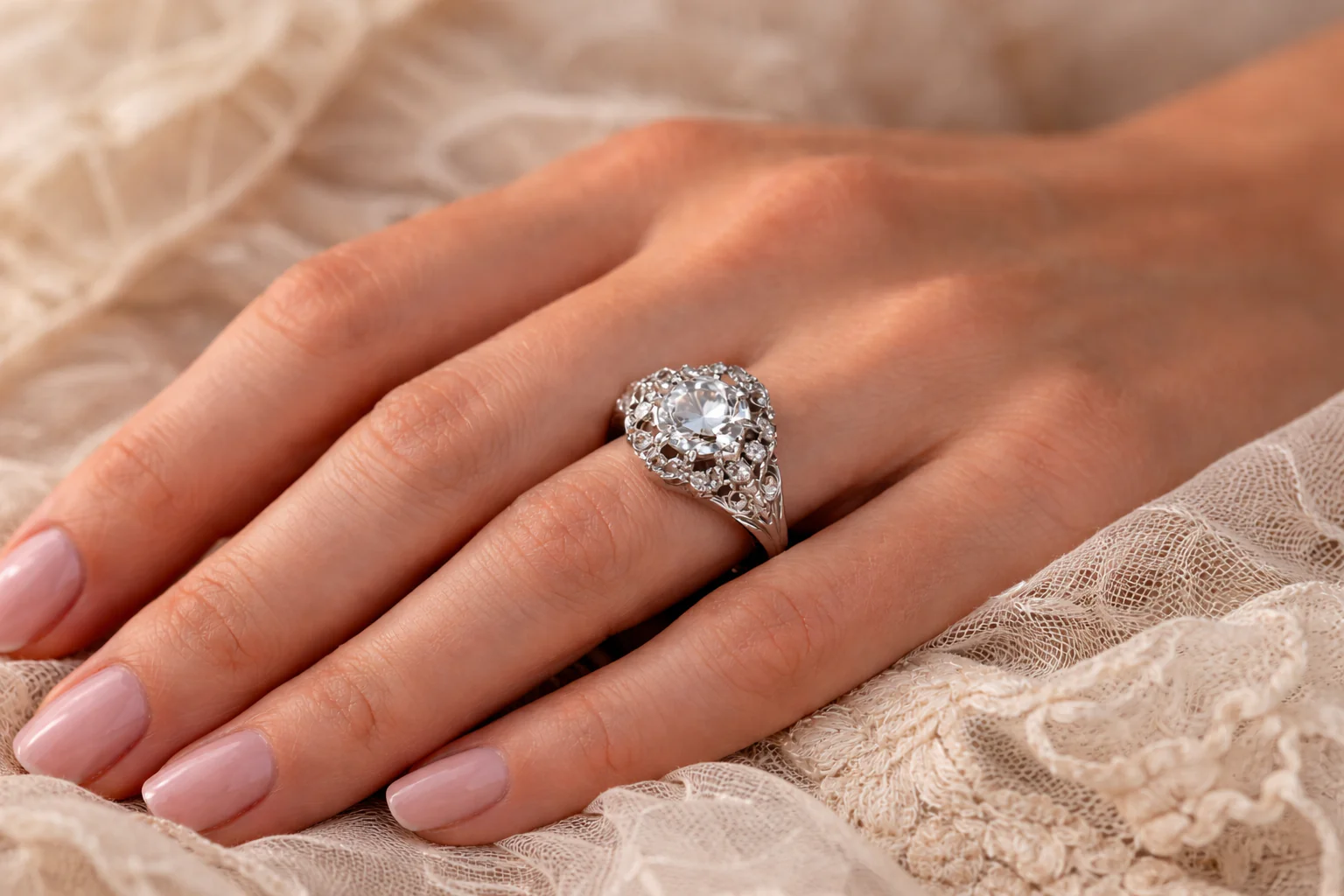
Choosing a ring with a century of history behind it is a fundamentally different experience from selecting a contemporary piece. Antique engagement rings are not simply older versions of modern jewelry — they are artifacts from distinct periods in design and manufacturing history, each with its own visual language, technical characteristics, and cultural context. For couples drawn to something genuinely one of a kind, and for collectors pursuing pieces of lasting significance, understanding the landscape of antique rings — what defines each era, what to look for, and how to approach the purchase — is the foundation of any well-considered decision.
What “Antique” Actually Means in the Jewelry Market
In the jewelry trade, the term “antique” carries a precise meaning: a piece must be at least one hundred years old to be accurately classified as such. This distinguishes antique jewelry from “vintage” pieces, which are generally defined as falling between twenty and one hundred years of age, and from “estate” jewelry, a broader term that simply refers to any previously owned piece regardless of its production date.
For engagement ring buyers, this distinction matters in practical terms. A true antique ring was produced during the Victorian, Edwardian, or early Art Deco period — before the manufacturing technologies that fundamentally transformed jewelry production in the mid-twentieth century. That historical threshold is a meaningful part of what gives these pieces their rarity and their sustained market value.
The Major Eras and What They Produced
Understanding antique engagement rings begins with recognizing the design periods that shaped them and the distinct characteristics each brought to fine jewelry:
The Victorian Era (1837–1901) — Jewelry from this period reflects the romanticism and deep sentimentality of the age. Yellow and rose gold were the primary metals, and rings frequently incorporated symbolic motifs — flowers, serpents, hearts, and clasped hands carried specific meaning for Victorian wearers. Gemstones beyond diamonds were common, with sapphires, rubies, garnets, and seed pearls appearing in elaborate cluster and target settings.
The Edwardian Era (1901–1915) — The Edwardian period introduced platinum into mainstream fine jewelry, enabling settings of previously unachievable delicacy. Rings from this era are defined by lacy filigree metalwork, intricate open-lattice construction, and an overall lightness of form. Old European cut diamonds in white platinum settings are the defining image of Edwardian engagement jewelry.
The Art Deco Period (1920s–early 1940s) — A decisive break from Edwardian softness, Art Deco embraced geometric precision, bold symmetry, and strong visual contrast. Angular profiles, step-cut stones, and graphic pairings of diamonds with onyx or colored gemstones characterize the era’s most celebrated work.
Signature Design Details Worth Recognizing
Across antique periods, several recurring details assist buyers in identifying and evaluating pieces with greater confidence.
Milgrain edging — a fine beaded border applied along the perimeter of a setting — appears consistently throughout Edwardian and Art Deco jewelry and is one of the most reliable hallmarks of pre-1940s fine craftsmanship. Old European cut diamonds, distinguished by their smaller table facets and larger culet, are the stone type most closely associated with antique engagement rings and produce a distinctly warm, romantic light return that differs visibly from modern brilliant cuts. Filigree metalwork, hand engraving, and rose-cut stones are additional indicators of genuine period workmanship that are difficult to replicate convincingly in modern reproduction pieces.
Why Antique Rings Resonate With Modern Couples
The sustained appeal of antique engagement rings among today’s buyers reflects values that contemporary jewelry is not equipped to deliver. Authenticity is central — every genuine antique ring is singular, produced by hand through processes that cannot be industrially recreated. A couple choosing an antique ring is selecting a piece that exists nowhere else in identical form.
The standard of period craftsmanship is another consistent draw. Jewelry produced before mid-century mechanization reflects an era when ring-making was a precision trade practiced by highly skilled artisans. Well-made platinum Edwardian and Art Deco pieces, in particular, have demonstrated structural durability across generations of continuous wear.
For sustainability-conscious buyers, the case is equally clear. Acquiring an antique engagement ring requires no new mining, no new refining, and no new manufacturing — a consideration that carries growing weight for a significant and expanding segment of today’s couples.
Evaluating and Authenticating a Purchase
Acquiring an antique engagement ring requires a level of diligence beyond what a standard jewelry purchase demands. Condition assessment should address prong integrity, metal thickness at the shank, and whether any stones show movement within their settings. Light surface wear is consistent with genuine age and is generally acceptable; structural compromise requires professional attention before the ring is worn daily.
Authentication is best approached through a combination of visual assessment — period-appropriate cuts, construction methods, and any visible hallmarks — alongside provenance documentation where available. Purchasing from a specialist with a demonstrable and documented record in antique jewelry is the most reliable safeguard against acquiring a reproduction or misattributed piece.
A Ring With a History Worth Having
An antique engagement ring offers what no contemporary piece of jewelry can provide: a documented place in design history, a form shaped by a specific cultural moment, and a standard of craftsmanship measured against the finest work of its era. For couples who want their ring to carry genuine meaning alongside its beauty, choosing antique is not simply an aesthetic decision — it is a considered statement about what endures.
Gesner Estate Jewelry maintains an expertly curated collection of authenticated antique and vintage engagement rings spanning the Victorian, Edwardian, and Art Deco periods. Visit their website to explore a selection of pieces that bring the artistry and intention of the past to one of life’s most significant moments.
