



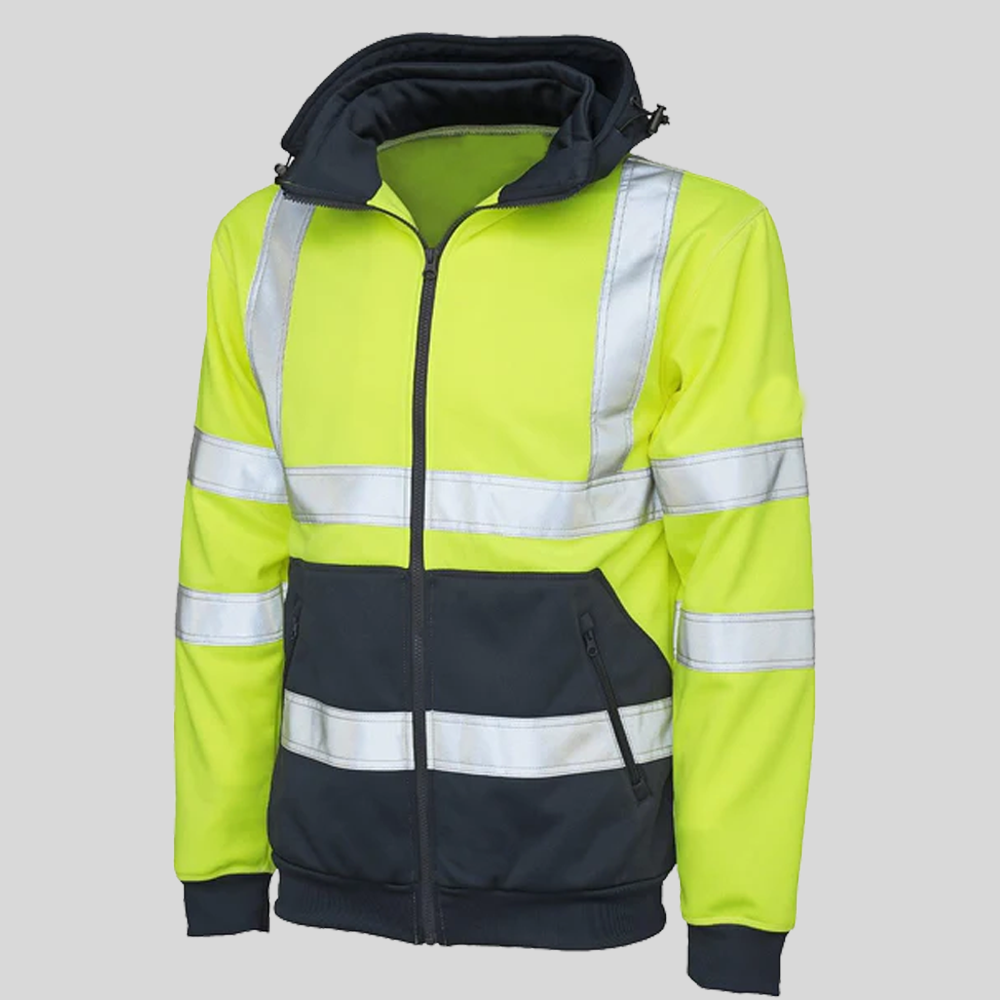
In the range of high-visibility garments available for seasonal installation and facility management crews, the hoodie occupies a practical middle ground that other garment categories do not fill: warmer than a performance shirt, more comfortable than a structured jacket, and more versatile than a stand-alone vest. A hi vis hoodie combines the familiar comfort of sweatshirt construction with ANSI-compliant fluorescent fabric and retroreflective striping — creating a safety garment that workers actively want to wear. In any occupational safety program, worker willingness to maintain a garment consistently throughout a shift is as practically significant as any certification standard the garment carries on its label.
Where the Hi-Vis Hoodie Fits in the Safety Garment System
A well-specified PPE program for a holiday installation crew typically includes multiple garment layers calibrated to different conditions: a performance base layer for active exertion, a vest for moderate visibility requirements, and an insulated outer jacket for sustained cold weather. The hi-vis hoodie fills the mid-layer position in that system — one that conventional PPE programs often leave unaddressed or assign to non-compliant civilian garments.
As a sweatshirt-construction safety garment with thermal properties that exceed a performance shirt but fall well short of an insulated jacket, the hi-vis hoodie serves the temperature range — roughly 40 to 60 degrees Fahrenheit — where a full jacket creates excessive bulk and heat while a shirt alone is insufficient for sustained outdoor comfort. For installation crews working through autumn pre-season setup and early winter conditions, this temperature band describes a significant portion of the operational calendar rather than a narrow exception.
The Hood: A Practical Advantage in Holiday Installation Environments
The defining feature that separates a hi-vis hoodie from a standard high-visibility sweatshirt is the integrated hood, and its value in holiday installation contexts is practical rather than aesthetic.
Installation crews working outdoors during November and December regularly encounter rain, wind-driven cold, and sustained morning chill during early setup periods before ambient temperatures rise to workable levels. An integrated hood that covers the head and neck without requiring a separate piece of equipment addresses those conditions directly — eliminating management of an additional item during already equipment-heavy installation work. For workers on elevated platforms, aerial lifts, and rooftop positions where wind exposure is considerably amplified above ground level, this protection becomes relevant not just to comfort but to the sustained focus and coordination that safe elevated work requires.
ANSI Compliance and How the Hoodie Fits the Layering Equation
High-visibility hoodies carrying ANSI/ISEA 107 Class 2 certification provide fully compliant standalone coverage for environments that meet Class 2 conditions — the standard applicable to the majority of commercial holiday installation contexts, including parking lots, shopping center environments, and mixed pedestrian-vehicle spaces.
Where Class 3 compliance is the required standard, the hi-vis hoodie integrates directly into a two-garment layering solution. A Class 2 certified hoodie worn under a Class 2 compliant safety vest elevates the combined visible coverage area to Class 3 compliance in many configurations, while the hoodie simultaneously addresses the insulation requirement that a vest alone cannot provide. This combination — hoodie beneath vest — gives installation crews Class 3 compliant visibility alongside mid-weight warmth in a system more flexible, comfortable, and adaptable to the variable temperatures of a December workday than a single heavy outer garment.
Why Comfort-Driven PPE Compliance Is a Legitimate Safety Strategy
In occupational safety management, worker acceptance of PPE is a dimension of real-world compliance that formal certification cannot resolve. A garment that meets every ANSI requirement but generates discomfort that leads workers to remove it during active tasks delivers demonstrably less on-site protection than a slightly lower-specification garment that workers maintain without resistance through the full shift.
The hoodie construction — soft interior fleece, flexible fabric that moves with the body, and the familiar form factor workers choose voluntarily outside of work — is one that generates genuine preference. That preference translates into better PPE retention during demanding installation tasks and during the warmer portions of variable-temperature workdays when workers are most likely to remove compliance garments.
Specifying a hi-vis hoodie for crews in conditions where it is appropriate is not an accommodation of worker comfort at the expense of compliance — it is a practical compliance strategy that recognizes the relationship between garment acceptance and actual PPE performance on site.
Where Hi-Vis Hoodies Serve Seasonal Operations Best
Across the operational environments of holiday installation and seasonal facility management, several specific contexts align particularly well with the capability profile of a hi-vis hoodie.
Commercial decorator crews working the shoulder season from October through mid-November — before temperatures consistently require heavy insulated outerwear — benefit from appropriate warmth and Class 2 compliance without the cost, weight, or bulk of a full jacket deployment. Warehouse receiving teams processing peak holiday inventory face variable temperature exposure at loading docks and receiving areas; the hoodie’s breathability during high-activity periods and warmth during lower-intensity intervals suits that environment directly.
Large event venue setup crews working in interior spaces with inconsistent climate control benefit from the mid-weight flexibility the hoodie format provides — visible, thermally appropriate across a wide range of indoor temperatures, and comfortable enough that compliance is maintained through the full duration of setup and strike operations.
The Mid-Layer That Completes the Seasonal PPE Program
The hi-vis hoodie fills a specific gap in seasonal installation PPE that no other garment occupies: mid-weight warmth, ANSI compliance, integrated head protection, and the construction comfort that keeps workers visibly protected through the shifts that test tolerance for conventional safety garments. For commercial decorators, facility managers, and seasonal operations teams building out their PPE specifications for the holiday installation window, it is a garment worth including at the program level rather than leaving to individual worker discretion.
National Safety Gear carries high-visibility hoodies and reflective safety sweatshirts in configurations suited to professional installation crews and seasonal facility operations at every scale. Visit their website to explore compliant options matched to your crew’s environmental conditions and seasonal PPE requirements.
