



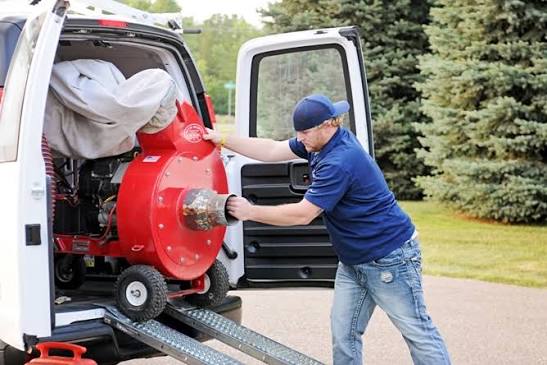
Whenever homeowners or facility managers picture air duct cleaning, they usually imagine a technician walking through the front door carrying a slightly oversized shop vacuum and a long wand. Then we back a commercial box truck into the driveway, unroll eight-inch-diameter ribbed vacuum hoses through the entryway, fire up a twin-turbine negative air machine, and pull out rotary pneumatic whips that look like something engineered for deep-space exploration. Understanding what actually happens behind your supply registers helps you separate genuine mechanical source removal from quick-and-dirty “blow-and-go” shortcuts that leave half the grime behind.
Creating Continuous Negative Pressure Across the Entire Network
The foundation of every legitimate duct restoration is establishing powerful negative air pressure inside your HVAC distribution system before a single speck of dust is disturbed. If you scrub the inside of a dirty trunk line without capturing the loosened debris immediately, you simply turn your air handler into a giant dust cannon that coats your furniture, electronics, and lungs. To prevent that, we start by temporarily sealing every supply register and return grille throughout the building with magnetic covers, foam blocks, or high-tack protective film.
Next, we cut a clean, circular access port directly into the main supply trunk and return plenum near the air handler, attaching a heavy-duty collection collar connected to an industrial HEPA-filtered vacuum unit. Capable of pulling anywhere from 3,500 to 5,000 cubic feet of air per minute, this containment rig turns your entire duct network into a closed, high-velocity vacuum tunnel. Utilizing truenegative pressure duct cleaning guarantees that every particle dislodged inside distant branch runs gets sucked straight toward the containment unit rather than escaping into your living room or office.
Agitation Tools That Scour Metal and Flex Duct Safely
High suction alone moves loose dust, yet stubborn debris, such as caked pet hair, cooking aerosols, drywall dust, and decades-old lint, clings tightly to galvanized sheet metal corners and corrugated flex-duct ribbing. That is where specialized agitation tools enter the picture. Depending on the construction of your ductwork, a technician selects either compressed-air whips or electrically driven rotary brush systems to physically scrub every square inch of the interior surface.
Air whips use high-pressure compressed air fed at 150 to 200 PSI through flexible polyurethane hoses tipped with multi-stranded silicone or nylon tentacles. As the whip feeds down a branch line, the tentacles spin rapidly, slapping against the duct walls to break loose stubborn grime while backward-facing air jets propel loosened debris directly toward the main trunk vacuum. For rigid rectangular metal trunks, soft-bristle rotary brushes spinning on flexible drive cables reach into ninety-degree corners without scratching protective zinc coatings or tearing delicate fiberglass duct board.
Navigating Zone Dampers, Plenums, and Air Handler Components
Modern residential and commercial HVAC systems rarely consist of straight, simple pipes. Behind drywall and above acoustic ceiling tiles, we encounter motorized zone dampers, acoustic turning vanes, flex-duct takeoffs, and delicate evaporator coils. An experienced technician maps the airflow zones before starting, opening manual balancing dampers and carefully guiding agitation lines around fragile flex transitions so nothing gets disconnected or punctured inside an inaccessible chase.
Once the trunk and branch runs are scoured clean, attention turns to the mechanical heart of the system: the blower wheel, evaporator coil cabinet, and drain pan. Using precision air lances, non-corrosive coil cleaners, and HEPA vacuums, we clear packed dust from the curved blades of the squirrel-cage blower wheel so static pressure and airflow return to original factory specifications.
Three-Stage HEPA Filtration Protects Your Indoor Environment
A common worry among clients with allergies or sensitive commercial equipment is whether running giant vacuum hoses indoors will kick up fine dust into the room. Professional containment rigs eliminate that risk through multi-stage filtration. First, heavy debris and large dust bunnies drop into a primary collection chamber. Next, air passes through pleated pre-filters that capture mid-sized particles before hitting a certified true HEPA final filter rated to trap 99.97 percent of particulates down to 0.3 microns.
Because the exhaust air leaving the machine is cleaner than the ambient air in most rooms, portable electric HEPA units can even be stationed indoors in high-rise condos, medical suites, or multi-story office buildings where truck-mounted hoses cannot reach.
Closing Up Properly: Access Panels and Airflow Verification
When the last branch run passes inspection, often verified via borescope camera or before-and-after photos, every circular service hole cut into your main plenums is sealed permanently using oversized galvanized sheet metal patches, foil-backed mastic tape, and mechanical fasteners. No air leaks, no whistling seams, and no DIY duct tape that dries out and peels off six months later.
Real Machinery Delivers Real Clean Air
Effective air duct cleaning is an engineering process built on airflow physics, mechanical agitation, and sealed HEPA containment, not guesswork or cheap coupons. Knowing how professional equipment works empowers you to ask smarter questions, protect your HVAC investment, and verify that the entire distribution network is genuinely spotless from the farthest register back to the blower motor.
