



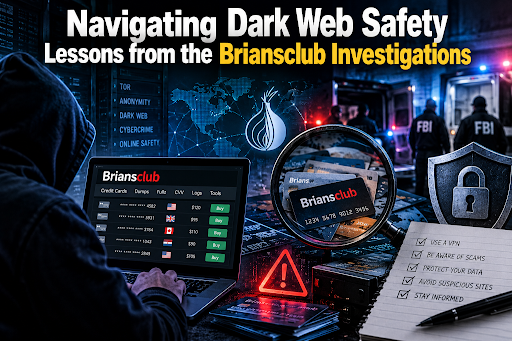
The dark web attracts attention for obvious reasons. It is associated with anonymity, hidden services, cybercrime forums, stolen data, cryptocurrency, and marketplaces that deliberately operate outside the conventional internet.
But investigating this environment is very different from simply browsing the web.
The history of briansclub offers a useful case study. The marketplace became one of the better-documented underground shops associated with stolen payment-card information. In 2019, an attacker breached BriansClub and extracted more than 26 million stolen payment-card records. The information eventually reached cybersecurity journalists, academic researchers, and organizations involved in payment-fraud prevention.
That incident created an unusual research opportunity. Instead of relying entirely on rumors or criminal advertisements, researchers could examine actual marketplace data and study how the underground economy functioned.
It also demonstrated something equally important: investigating cybercrime requires its own security discipline.
Whether you are a journalist, academic researcher, threat-intelligence analyst, or cybersecurity professional, the BriansClub case offers practical lessons about evidence handling, source verification, operational security, privacy, and responsible reporting.
What Was Briansclub?
BriansClub was an illicit marketplace associated with stolen credit and debit card information.
According to NYU researchers, data extracted from the marketplace covered activity from 2015 through 2019. Their analysis identified more than 19 million unique card numbers listed for sale and estimated approximately $104 million in gross revenue during the period examined. The researchers estimated roughly $24 million in profit.
The marketplace also became notable because it appropriated the name and likeness of cybersecurity journalist Brian Krebs.
That branding was not merely a curiosity. It became part of the broader story because KrebsOnSecurity subsequently reported extensively on BriansClub and its 2019 breach.
For researchers studying the underground economy, the marketplace provided an unusual opportunity to examine how stolen financial information was supplied, priced, purchased, and redistributed.
The 2019 Briansclub Breach
The most important event in the publicly documented history of BriansClub occurred in 2019.
Someone breached the marketplace and extracted more than 26 million stolen credit and debit card records. The data was eventually provided to KrebsOnSecurity, which shared it with researchers and organizations working to combat payment-card fraud.
The incident is sometimes casually described as a “shutdown.”
That wording needs care.
The available reporting describes a compromise of BriansClub itself rather than a conventional law-enforcement seizure. The distinction matters because researchers examining cybercrime should separate:
- A criminal service being hacked
- A service going offline
- A domain being seized
- Servers being confiscated
- Operators being arrested
- Criminal proceeds being frozen
- An investigation continuing behind the scenes
These are different events and require different evidence.
That distinction is one of the first lessons from the BriansClub case: never turn an assumption into an investigative fact.
Why the Briansclub Case Matters for Dark Web Research
Most underground services are difficult to study directly.
Researchers may encounter incomplete information, fabricated claims, copied material, impersonation, manipulated statistics, and sources with obvious incentives to mislead.
The BriansClub dataset was unusual because it provided a large amount of underlying transactional information.
NYU researchers used that data to study the marketplace’s business model, sellers, customers, inventory, and finances. Their research found that approximately 97% of the marketplace’s inventory consisted of magnetic-stripe data, while customers purchased only about 40% of that inventory. By contrast, approximately 83% of card-not-present inventory was purchased.
Those numbers demonstrate why evidence matters.
An underground marketplace might claim to have enormous demand. Actual transaction records can tell a different story.
Lesson 1: Start With Evidence, Not the Story
Cybercrime investigations often begin with a compelling claim:
“A major database was stolen.”
“A criminal marketplace has been taken down.”
“Millions of accounts are for sale.”
“A hacker group has compromised a major company.”
The first job is not to repeat the claim.
It is to establish what can actually be demonstrated.
A strong investigative workflow separates information into categories such as:
Confirmed facts
Information directly supported by reliable evidence.
Reported claims
Statements made by researchers, journalists, companies, criminals, or other identifiable sources that still require context.
Inferences
Conclusions drawn from multiple pieces of evidence.
Unknowns
Questions that remain unresolved.
This simple separation can prevent major errors.
In the BriansClub case, for example, the existence of the 2019 breach and the scale of the extracted dataset are substantially documented. But describing every consequence of that breach as a government “shutdown” would go beyond what the available evidence establishes.
Lesson 2: Do Not Treat the Dark Web Like an Ordinary Website
One of the biggest mistakes inexperienced researchers make is applying normal browsing habits to hostile environments.
A conventional website may contain advertising, tracking scripts, analytics, malicious downloads, phishing pages, or compromised content. A criminal marketplace can introduce additional risks involving malware, scams, credential theft, surveillance, and exposure to illegal material.
That changes the risk calculation.
A responsible investigation should minimize unnecessary interaction.
The objective should be:
Collect the evidence you need without becoming part of the environment you are studying.
For many investigations, that means relying heavily on:
- Public reporting
- Academic research
- Security-company reports
- Court documents
- Law-enforcement announcements
- Archived material
- Existing threat-intelligence datasets
- Previously collected evidence
You do not necessarily need direct access to a criminal service to understand what it does.
Lesson 3: Separate Research From Participation
There is a fundamental difference between observing criminal activity and participating in it.
Researchers should not purchase stolen credentials, payment-card information, malware, or other illicit goods simply to “see what happens.”
Apart from legal and ethical concerns, direct participation can create serious security risks.
It can also contaminate an investigation.
Once a researcher begins interacting with criminals, the researcher becomes another participant in the environment. That can affect the evidence, create attribution problems, expose identities, and complicate later reporting.
The BriansClub investigation illustrates the value of studying existing evidence rather than attempting to recreate criminal activity.
NYU researchers were able to produce significant findings from data that had already been extracted from the marketplace.
Lesson 4: Protect Your Research Environment
Cybersecurity researchers should assume that hostile infrastructure is hostile.
That principle sounds obvious, but it has practical implications.
A research environment should be separated from:
- Personal accounts
- Personal email
- Banking information
- Work credentials
- Sensitive documents
- Primary browser profiles
- Unnecessary identifying information
The exact technical architecture will depend on the organization and investigation, but the broader principle is universal:
Do not mix investigative activity with ordinary personal computing.
Security teams commonly use controlled environments, restricted permissions, dedicated accounts, monitoring, and carefully managed evidence repositories.
The goal is containment.
If something goes wrong, the incident should remain isolated from the researcher’s personal and organizational systems.
Lesson 5: Minimize Your Digital Footprint
Anonymity and security are not the same thing.
A researcher might successfully hide an IP address and still reveal information through browser configuration, account behavior, document metadata, timing patterns, usernames, language, or other identifying characteristics.
The safest approach is therefore not to assume that one privacy technology makes an investigator anonymous.
Instead, researchers should practice data minimization.
Ask:
- Does this investigation require me to create an account?
- Do I need to provide identifying information?
- Does the source need to know who I am?
- Am I revealing information about my employer?
- Am I unnecessarily communicating with a criminal actor?
- Could this interaction expose someone else?
Every additional interaction creates another potential source of risk.
Lesson 6: Preserve Evidence Before Drawing Conclusions
Digital evidence can disappear quickly.
Websites change. Accounts are deleted. Domains move. Criminal operators modify content. Screenshots can lose context. Search results can change.
A professional investigation therefore needs an evidence-preservation strategy.
Useful practices include documenting:
- Date and time of collection
- Source location
- Relevant screenshots
- Original files
- Hashes where appropriate
- Research notes
- Chain of custody
- Who accessed the evidence
- What transformations were performed
The objective is reproducibility.
Another researcher should be able to understand how you reached your conclusion.
Why Chain of Custody Matters
Suppose a researcher discovers information connected to bclub and later publishes an article about it.
Without careful documentation, readers may reasonably ask:
- Was the information authentic?
- Was it modified?
- When was it collected?
- Who originally obtained it?
- Was the material independently verified?
- Could the account have been fabricated?
Evidence handling helps answer those questions.
It turns an interesting screenshot into something much more useful: a documented investigative record.
Lesson 7: Corroborate Before Publishing
A single dark-web source should rarely be treated as definitive.
Criminal communities have incentives to exaggerate.
A seller may claim access to millions of records when the actual dataset is much smaller. A forum member may falsely claim responsibility for an attack. A marketplace administrator may publish misleading statistics to attract customers.
Good investigators therefore look for independent confirmation.
For a BriansClub-related claim, useful corroborating sources could include:
- Academic research
- Established cybersecurity journalism
- Law-enforcement statements
- Financial-sector notifications
- Incident-response reports
- Independent technical analysis
The more serious the claim, the stronger the corroboration should be.
Lesson 8: Understand What the Data Actually Shows
The BriansClub research provides a good example of why interpretation matters.
NYU researchers found more than 19 million unique card numbers listed by the marketplace. Yet approximately 60% of those accounts did not find buyers.
That means the statement:
“BriansClub had millions of stolen cards”
can be factually supported.
But the statement:
“Criminals purchased all those cards”
would not be supported by the same research.
The difference may seem small, but it is exactly the kind of distinction that separates careful cybersecurity reporting from sensationalized coverage.
Lesson 9: Protect Victims, Not Just Sources
Dark-web investigations can involve stolen personal and financial information.
That creates an ethical responsibility.
Researchers and journalists should avoid unnecessarily publishing:
- Full payment-card numbers
- Authentication credentials
- Personal addresses
- Government identification numbers
- Private correspondence
- Unredacted victim information
- Information that could enable further fraud
The fact that data is already circulating does not automatically make republication appropriate.
A useful question is:
Does publishing this specific piece of information advance the public-interest investigation, or merely expose another victim?
If the second answer is more accurate, the information should generally remain private or be appropriately redacted.
Lesson 10: Do Not Confuse Visibility With Safety
The BriansClub case generated enormous visibility because of its scale.
But visibility does not mean the underlying threat disappeared.
KrebsOnSecurity later reported evidence suggesting that BriansClub-related activity continued after the 2019 breach, including cryptocurrency activity associated with the marketplace.
This illustrates a broader cybercrime principle.
A website can disappear.
A domain can be seized.
A database can leak.
An administrator can disappear.
Yet the underlying criminal economy can continue elsewhere.
Researchers should therefore investigate ecosystems rather than focusing exclusively on individual websites.
A Practical Dark Web Safety Framework
For legitimate researchers, journalists, and security professionals, a useful framework is:
1. Define the question
Know exactly what you are investigating.
2. Start with open sources
Look for credible reporting, research papers, court records, and official statements.
3. Assess the risks
Identify legal, technical, privacy, and personal-safety concerns before interacting with potentially hostile infrastructure.
4. Minimize interaction
Observe where possible. Do not participate unnecessarily.
5. Isolate research activity
Keep investigative work separated from personal and sensitive systems.
6. Preserve evidence
Record where information came from and how it was obtained.
7. Corroborate
Look for independent evidence before treating an allegation as fact.
8. Protect victims
Redact unnecessary personal and financial information.
9. Document uncertainty
Clearly distinguish what is known from what is suspected.
10. Report responsibly
Publish findings without exposing unnecessary details that could facilitate additional harm.
What the BriansClub Investigation Teaches Us
The BriansClub case is particularly useful because it combines several challenges at once.
It involved an illicit marketplace, stolen financial information, anonymous operators, cryptocurrency, a massive breach, journalists, academic researchers, and financial institutions.
Yet some of the most valuable lessons are surprisingly straightforward.
Evidence beats speculation.
Minimizing interaction is safer than unnecessary engagement.
A leaked database is not automatically proof of every claim made about it.
A criminal marketplace being hacked is not necessarily the same thing as a government seizure.
Publishing sensitive information requires consideration of victims, not just readers.
And perhaps most importantly, researchers should remember that the goal is not to become an expert at navigating criminal environments.
The goal is to understand them while reducing risk.
BriansClub and the Future of Cybercrime Research
The data recovered from BriansClub helped researchers examine a hidden economy at a level of detail that would normally be difficult to achieve.
The NYU study showed that the marketplace had substantial revenue, millions of listed accounts, distinct patterns of buyer demand, and measurable responses to changes in payment technology.
That kind of research can help defenders understand where fraud pressure moves when security controls change.
For example, the researchers found that card-not-present information was in comparatively high demand, while magnetic-stripe data dominated the marketplace’s inventory. They also found that chip-enabled cards were not immune from exposure because their magnetic stripes remained usable in some transaction environments.
The broader lesson is that cybersecurity is rarely a one-time problem.
Attackers adapt.
Defenders adapt.
Researchers need to understand both sides without unnecessarily becoming part of the criminal environment.
Final Thoughts
The story of briansclub, bclub, and brians club is often presented as a story about a notorious dark-web marketplace.
It is also a valuable lesson in investigative discipline.
The 2019 BriansClub breach exposed more than 26 million stolen payment-card records and eventually enabled researchers to examine the marketplace using unusually detailed underlying data.
What followed demonstrated the value of careful research. NYU researchers were able to quantify the marketplace’s scale, examine buyer behavior, and study how criminals responded to changes in payment technology.
For anyone researching dark-web activity, the central lesson is not how to enter these environments.
It is how to investigate responsibly without unnecessarily increasing your exposure or the harm to others.
That means starting with reliable sources, minimizing direct interaction, isolating research systems, preserving evidence, corroborating important claims, protecting victims, and being precise about what the evidence actually proves.
The BriansClub investigation demonstrates that high-quality cybercrime research does not depend on taking unnecessary risks. In many cases, the strongest findings come from combining existing evidence, independent sources, careful analysis, and disciplined documentation.
That approach is safer for researchers—and far more useful for everyone trying to understand the cybercrime ecosystem.
