



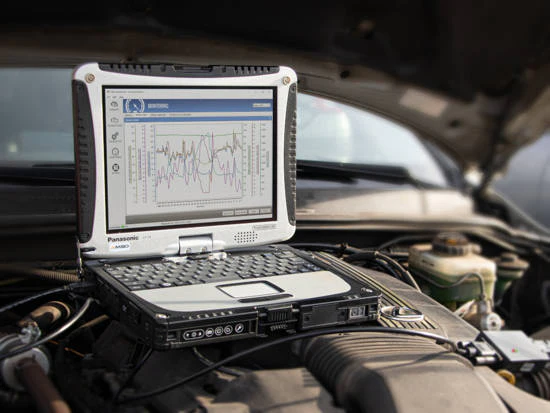
The rugged computing market is not a binary choice between a standard business laptop and a device hardened to the most extreme military specification. Between those two endpoints sits a category that serves the largest share of field professionals in practice: the semi-rugged laptop. Understanding what this category actually provides — how it differs from consumer hardware and from fully rugged alternatives, where it performs best, and critically, when it is not the right choice — is the foundation of a procurement decision that accurately matches hardware to operational requirements rather than over- or under-specifying against them.
Defining the Semi-Rugged Category
The rugged computing market is typically described across three tiers: standard commercial hardware, semi-rugged devices, and fully rugged devices. Semi-rugged laptops occupy the middle tier — structurally reinforced, certified against defined environmental standards, and built to outlast commercial hardware in field conditions, while stopping short of the maximum hardening that fully rugged devices carry.
In practical terms, semi-rugged laptops are designed for the working conditions most field professionals actually encounter: vehicle transport vibration, occasional drops, temperature variation across a working day, humidity exposure, and the sustained physical stress of use outside a controlled office environment. These are not marginal improvements over commercial alternatives — they represent a measurable and independently verifiable step up in durability that directly reduces hardware failure rates, operational downtime, and replacement frequency in field deployment.
How Semi-Rugged Differs from Fully Rugged
The distinction between semi-rugged and fully rugged is most clearly understood across four dimensions: construction, certification, environmental protection, and intended operational context.
Fully rugged construction features sealed ports, bonded displays, and heavily reinforced hinges engineered to survive immersion, extreme temperature swings, sustained vibration, and direct impact in the most hostile environments. Semi-rugged construction uses reinforced materials — typically magnesium alloy and composite — without fully sealed ports, calibrated for less extreme but still genuinely demanding conditions.
Certification coverage reflects this difference. Fully rugged devices carry broader MIL-STD-810 coverage across more categories and more extreme test thresholds. Semi-rugged devices carry certification relevant to their deployment context — shock, vibration, temperature, humidity — without the full breadth of extreme-condition testing.
Ingress protection is often the clearest differentiator: fully rugged devices typically carry IP65 or higher ratings for dust and water resistance; semi-rugged devices provide spill and weather resistance without a formal IP designation.
Construction and Certification Characteristics Worth Evaluating
Within the semi-rugged category, certain construction and certification characteristics serve as reliable criteria when evaluating specific devices.
Chassis construction using magnesium alloy or reinforced composite provides impact resistance and structural rigidity that commercial alternatives cannot match without the weight penalty of maximum-hardened enclosures. MIL-STD-810 certification represents an independently verified durability threshold — tested against defined laboratory protocols — that commercial hardware does not achieve and that provides a meaningful baseline for comparing devices across the semi-rugged tier.
Spill-resistant keyboards, reinforced port areas, and display protection address the failure modes most frequently encountered in field environments. Battery specifications calibrated for extended shift operation rather than controlled desk use are a further indicator of genuine semi-rugged design intent, separating purpose-built field hardware from commercial devices with only superficial hardening applied.
When a Semi-Rugged Laptop Is the Right Choice
The semi-rugged laptop is the correct specification when the working environment is demanding but not extreme, and when full laptop usability — a complete keyboard, standard display size, and broad enterprise software compatibility — is a genuine operational requirement rather than a preference.
Vehicle-based field work where the device is transported regularly but used in relatively controlled site conditions is a natural semi-rugged fit. Hybrid roles that move workers between office and field environments benefit from the meaningful durability improvement without the cost and weight of a fully rugged unit. Organizations deploying hardware in moderate climates, without exposure to immersion risk, extreme temperature ranges, or sustained heavy impact, will typically find that semi-rugged hardware meets their durability requirements with capacity to spare.
Total cost of ownership reinforces this choice: semi-rugged hardware costs less than fully rugged at the procurement stage while delivering substantially lower replacement rates than commercial hardware — an outcome that often represents the optimal cost position across the full device lifecycle.
When You Need to Go Fully Rugged Instead
Understanding the limits of semi-rugged capability is as important as knowing its strengths.
Deployments involving sustained rain exposure, water immersion risk, or operation in heavily contaminated environments — dust, debris, or chemical exposure — require the sealed construction and IP rating that only fully rugged devices provide. Extreme temperature ranges beyond semi-rugged certification thresholds, and high-vibration industrial environments such as mining and heavy construction, impose mechanical demands that semi-rugged chassis construction is not designed to absorb.
For these contexts, fully rugged hardware is not over-engineering — it is accurate specification for the actual deployment environment. Under-specifying hardware against those conditions invariably produces higher total costs through accelerated failure rates, shortened service cycles, and the operational disruption that unplanned device replacement causes.
Match the Hardware Tier to the Actual Environment
The choice between semi-rugged and fully rugged hardware is an operational decision, not a prestige one. The right device is the one accurately specified for the conditions it will encounter — durable enough to survive the environment, practical enough to serve the workflow, and appropriately priced within the organization’s hardware lifecycle strategy.
Tough Rugged Laptops carries a full range of semi-rugged and fully rugged computing hardware, with the expertise to match device specifications to real-world operational requirements across industries. Visit their website to explore the full inventory and identify the hardware tier that fits your field environment and procurement needs.
